Driving all 2,448 miles of Route 66, from Chicago to Santa Monica, takes about 14 days at a comfortable pace, and 18 to 23 days if you want museums, side trips and a rest day or two. The pure driving time on the old road is roughly 50 to 60 hours, because most of it is two lanes and small towns. The fastest interstate route between the same two cities is a little over 2,000 miles and about 30 to 35 hours of driving. So yes, you can drive Route 66 in a week, but you will see much of it from I-40.
I'm Helena. In April 2026 I drove the whole road again, Chicago to Santa Monica, in 23 days, for the Centennial Edition of the Route 66 Field Manual. I was slow on purpose: I was checking every stop, calling motels and recording coordinates. Below is the honest math on how long Route 66 takes, and what actually happens to your trip at 5, 7, 10, 14 and 21 days.
How long is Route 66 in miles and km?
The historic route is 2,448 miles long, about 3,940 kilometers, and it crosses eight states: Illinois, Missouri, Kansas, Oklahoma, Texas, New Mexico, Arizona and California. That is the number you see on most maps and the one I use, but treat it as a reference rather than an odometer reading.
The road was realigned many times between 1926 and 1985, so the exact distance depends on which version you follow. The biggest swing is in New Mexico. The original road looped north through Santa Fe until 1937, and the later alignment cut straight west through Moriarty and saved about 107 miles. The state figures below include the Santa Fe loop, which is why New Mexico looks so long.
| State | Miles | Kilometers |
|---|---|---|
| Illinois | 301 | 484 |
| Missouri | 317 | 510 |
| Kansas | 13 | 21 |
| Oklahoma | 432 | 695 |
| Texas | 186 | 299 |
| New Mexico | 487 | 784 |
| Arizona | 401 | 645 |
| California | 316 | 509 |
| Total | 2,448 | about 3,940 |
If you want to see where each of those miles falls, town by town, I laid it out in the Route 66 map with cities.
How long does it take to drive Route 66 without stopping?
On the interstate, Chicago to Santa Monica is a little over 2,000 miles. Map apps put it at roughly 30 to 35 hours of driving, depending on traffic and how often you stop for fuel. That is the trip your phone will suggest if you let it.
On the old road, the time goes up for two reasons. First, the distance is longer, close to 2,448 miles instead of about 2,000. Second, you drive slower. Much of Route 66 is two-lane highway, frontage road and Main Street, with town speed limits, stoplights and the odd railroad crossing.
Here is the arithmetic I use. If you average 40 to 50 miles per hour across the whole route, counting towns and open desert together, 2,448 miles works out to about 50 to 60 hours behind the wheel. That is pure driving, before a single photo stop, a slice of pie or a museum. On my April trip the open stretches in Oklahoma and Arizona went quickly, and the city stretches in Chicago, St. Louis, Albuquerque and Los Angeles did not.
Nobody should drive Route 66 nonstop, of course. The number matters because it tells you how many hours of real driving you are committing to each day once you pick a trip length.
How many days do you need for Route 66?
Divide the miles by the days, then divide again by your average speed. This table does it for you, using the full 2,448 miles and an average of about 45 miles per hour on the old road.
| Trip length | Miles per day | Driving hours per day (old road) | What it feels like |
|---|---|---|---|
| 5 days | about 490 | about 11 | Not realistic on Route 66. This is an interstate trip with a few stops. |
| 7 days | about 350 | about 8 | A long drive every day. Full length only with lots of interstate, or half the road done properly. |
| 10 days | about 245 | about 5.5 | Doable and full of driving. You pick your stops in advance and skip the rest. |
| 14 days | about 175 | about 4 | The honest minimum for the whole road at a steady pace. |
| 21 days | about 117 | about 2.5 to 3 | Room for side trips, rest days and long lunches. |
Most couples I talk to end up at 14 days, and it is the length I built the Field Manual's main plan around. If you have the time, 18 to 23 days is where the trip stops feeling like a schedule.
What happens with 5, 7, 10, 14 or 21 days
The number of days changes more than your daily mileage. It changes which road you are on, which towns you sleep in, and whether you arrive at the motel before the office closes.
Route 66 in 5 days
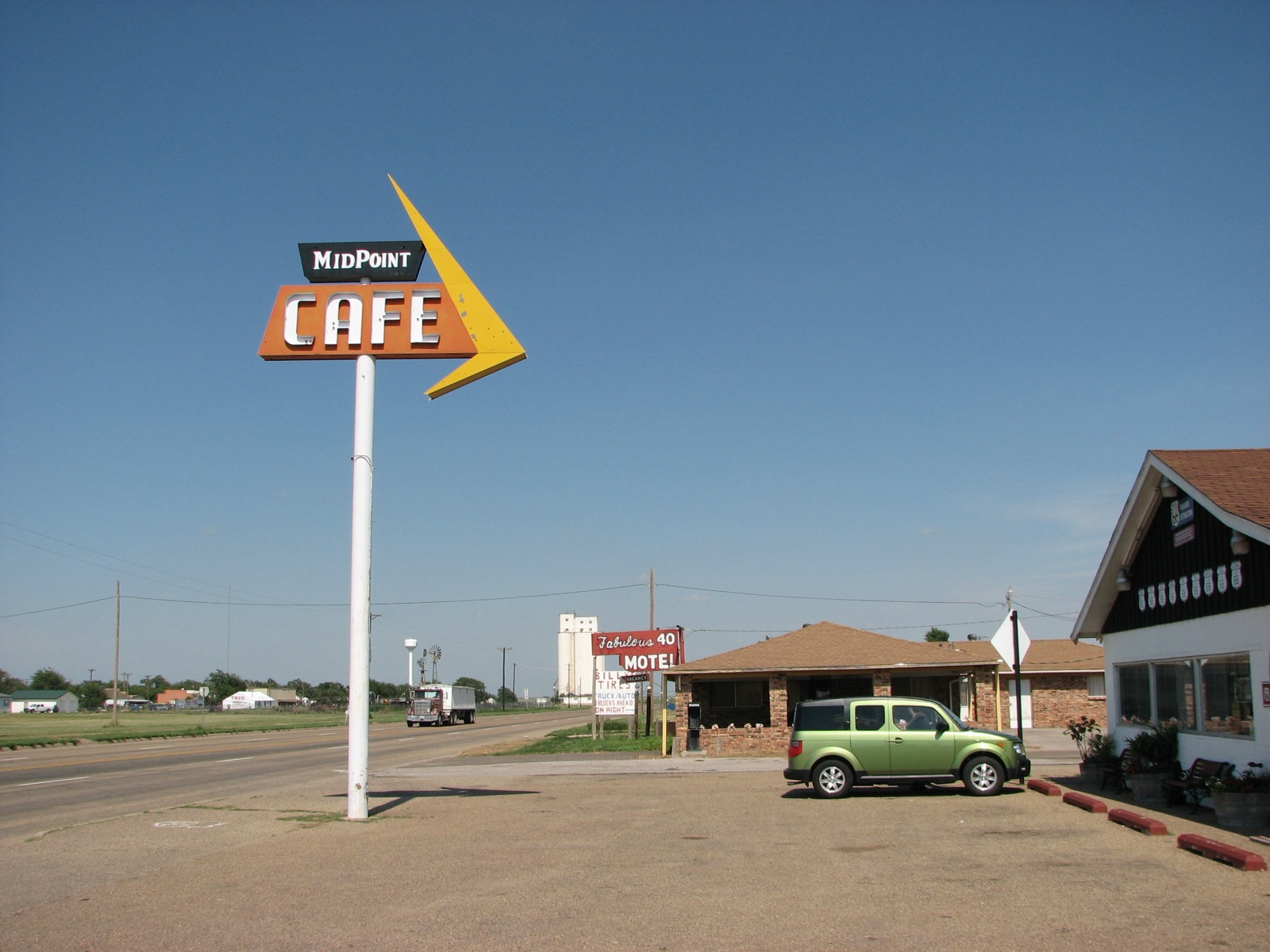
Five days means about 400 miles a day even on the interstate, so you will be on I-55, I-44 and I-40 almost the whole way. You can still touch Route 66: the Begin sign in Chicago, a frozen custard in St. Louis, Cadillac Ranch just off I-40 west of Amarillo, and the Midpoint Cafe in Adrian, Texas, which sits at mile 1,139, the halfway point of the route.
That is a fine road trip, but it is not really a Route 66 trip. If five days is what you have, I would rather see you drive one or two states slowly than all eight from the interstate.
Can you drive Route 66 in a week?
You can, and there are two good ways to do it. The first is the full length at about 350 miles a day: take the interstate through the stretches where the old road runs right beside it, like much of Missouri and the Texas Panhandle, and save your hours for Oklahoma, New Mexico and Arizona. Expect eight-hour driving days.
The second way is the one I recommend: drive half the road properly. Chicago to Oklahoma City, or Albuquerque to Santa Monica, is roughly 850 to 900 miles each. Over seven days that is a relaxed 125 miles or so a day, with time to stop. The western half has the desert, the Petrified Forest pullout, Seligman and the climb over Sitgreaves Pass to Oatman. The eastern half has the Illinois small towns, Missouri, the 13 Kansas miles and the long Oklahoma stretch.
Route 66 in 10 days
Ten days gets you the whole road at about 245 miles a day, or five and a half hours of driving. It works if you accept two things. You will pick a short list of stops in advance and drive past many others, and you will use the interstate in a few places to buy time.
I would take the 1937 alignment through New Mexico rather than the Santa Fe loop, and keep two long driving days for Texas and eastern New Mexico, where the old road is mostly I-40 frontage anyway. If you want more detail on where the interstate is the smart choice, I wrote about it in Route 66 vs I-40.
Route 66 in 14 days
Fourteen days is the trip most people picture: the whole road, mostly on the old alignments, about 175 miles and four hours of driving a day. You can stop at the museums, eat lunch sitting down and still reach your motel in daylight. I lay out every day of it in my 2-week Route 66 itinerary.
The one thing I would add is a buffer. A flat tire, a storm or a museum you cannot leave will eat half a day somewhere, so give one of the fourteen days a light schedule near the end.
Route 66 in 21 days
Three weeks is about 117 miles a day, under three hours of driving, and it changes the trip. You can do the Santa Fe loop, take a rest day in Albuquerque or Flagstaff, add the Grand Canyon from Williams, and still have mornings with nothing planned.
My April drive took 23 days, and I never felt rushed. The extra days went into the things that do not fit a tight plan: the conversation at the motel office, the second visit to a cafe because the pie was that good, and the afternoon a storm kept me in town.
How many days in each state?
Days do not split evenly by state, because the states are wildly different in length. Kansas has 13 miles, New Mexico close to 500. This is how I would divide a 14-day and a 21-day trip, driving east to west.
| State | Miles | Days in 14 | Days in 21 | Where the time goes |
|---|---|---|---|---|
| Illinois | 301 | 2 | 3 | Chicago traffic, then small towns like Wilmington and Pontiac |
| Missouri | 317 | 2 | 3 | St. Louis, then the long stretch beside I-44 to Joplin |
| Kansas | 13 | Half a morning, shared with Oklahoma | Galena and the Rainbow Bridge | |
| Oklahoma | 432 | 2.5 | 3.5 | The most drivable miles of any state, Tulsa and Oklahoma City |
| Texas | 186 | 1 | 1.5 | Shamrock, Amarillo, Cadillac Ranch, the Midpoint Cafe |
| New Mexico | 487 | 2.5 | 4 | Tucumcari, Santa Rosa, the Santa Fe loop if you take it, Albuquerque |
| Arizona | 401 | 2 | 3.5 | Petrified Forest, Holbrook, Flagstaff, Seligman, Oatman |
| California | 316 | 2 | 2 | The Mojave, then Los Angeles traffic to the pier |
| Total | 2,448 | 14 | 21 | |
Notice that California gets two days either way. The miles are not many, but the desert is best driven early in the day, and the last 30 miles into Santa Monica can take as long as a hundred miles in Oklahoma.
How many hours a day should you drive on Route 66?
My rule is four to five hours of actual driving, and never more than six. On Route 66 that already fills a day, because every hour of driving brings about an hour of stops if you are doing it right.
Three practical reasons to keep the daily number low:
- Motel offices close. Many of the classic motels are small family businesses. Arrive late and you may find a dark office and a note on the door.
- The desert is a morning drive. Needles, California, averages a high around 110°F in July. In summer, cross the Mojave early and be off the road by early afternoon.
- Westbound means driving into the sun. From Oklahoma on, late-afternoon driving puts the sun right in your eyes. Long stretches belong in the morning.
What adds time to a Route 66 trip (and what saves it)
A few things change the math more than people expect. Plan for them and the number of days you picked will hold.
- Closures and detours. In California, National Trails Highway from Kelbaker Road east to Essex has been closed for bridge replacement, after flash floods washed out the old timber bridges starting in 2014. The detour is I-40 and Kelbaker Road. In New Mexico, the gravel stretch from Glenrio to San Jon is rough after a 2023 bridge washout. Check road status before you go.
- The Santa Fe loop. It adds roughly a day. It is beautiful, and it is the first thing I cut on a short trip.
- Big-city traffic. Getting out of Chicago and into Santa Monica both take far longer per mile than anything in between. Avoid rush hour at both ends.
- Centennial events. Route 66 turns 100 on November 11, 2026. Festivals fill every motel in town, so check the centennial events calendar before you fix your dates.
- Season. Spring and fall give you the most daylight you can comfortably use. Winter means shorter days, snow risk around Flagstaff at about 7,000 feet, and some businesses on reduced hours. I wrote about why fall is my favorite in Route 66 in the fall.
What saves time is mostly planning. Knowing in the morning exactly where the old alignment leaves the interstate, and where you are sleeping that night, is worth an hour a day. That is the part your map app will not do for you, because it always wants you back on I-40.
Does direction change how long Route 66 takes?
Not really. East to west and west to east are the same miles. I drive east to west, because the trip builds from farm towns to desert and ends at the Pacific, but the days you need do not change.
Direction does change the price of a one-way rental, and the drop fee can be a big line in the budget. Price it both ways before you choose. If you are riding instead of driving, I put together a separate Route 66 motorcycle trip planner, because the daily mileage and the fuel stops work differently on two wheels.
Pick the number of days first
Everything else on Route 66 follows from how many days you have: which alignments you drive, where you sleep, how many hours you sit behind the wheel. Decide that first, then build the trip around it, and book the motels in the small towns before anything else, because those are the nights with the fewest choices. My list of the best Route 66 motels is a good place to start.
For the full plan, the Route 66 road trip planner covers season, direction, budget and closures. And if you want the whole road on paper, the Route 66 Field Manual has 169 maps and 105 GPS waypoints across all eight states, with 9 restaurants and 9 hotels per state on three budgets. The printed book and the digital edition come together in one order for $47.
See you on the road.